

_1200_x_650.webp)
Every year, thousands of aspirants prepare for the Civil Services Examination with countless assumptions about what it takes to secure a top rank. Many believe that extraordinary scores in every paper are necessary, that optional subjects alone determine success, or that the interview can dramatically change the final outcome. However, when actual scorecards of successful candidates are examined closely, a very different story emerges.
This analysis is based on detailed marks data from 39 successful candidates across multiple ranks, covering performance in Essay, all four General Studies papers, Optional subjects, Written totals, and Interview scores. By examining these numbers systematically, clear patterns begin to appear regarding how candidates actually score, where marks tend to cluster, and which papers create the biggest differences in rank.
Rather than relying on speculation or coaching myths, this article uses real data to uncover the true scoring dynamics of the UPSC examination. It highlights what the marks reveal about the role of consistency, the realistic score ranges in different papers, and the strategic importance of optional subjects, ethics, and answer writing.
For new aspirants and repeat candidates alike, the insights from this dataset provide a practical roadmap for building a targeted, focused, and efficient preparation strategy for the next attempt.
Top Scorers in Each Subject............................................................................................................................ 4
Top Scorers by Optional Subject..................................................................................................................... 4
Average Scores per Paper................................................................................................................................ 4
Myth vs Reality: Lessons from the UPSC CSE Score Data.......................................................................... 5
1. Myth: “You must score extremely high in every paper.”............................................................................ 5
2. Myth: “Optional subject alone decides the rank.”....................................................................................... 6
3. Myth: “Interview marks alone determine the final rank.”........................................................................... 6
4. Myth: “Essay paper is unpredictable and impossible to prepare.”............................................................. 6
5. Myth: “Ethics (GS4) is unpredictable.”....................................................................................................... 7
6. Myth: “GS papers must be mastered completely before attempting answer writing.”.............................. 7
7. Myth: “The highest scorers are perfect in all sections.”............................................................................. 7
8. Core Strategic Lessons from the Data....................................................................................................... 7
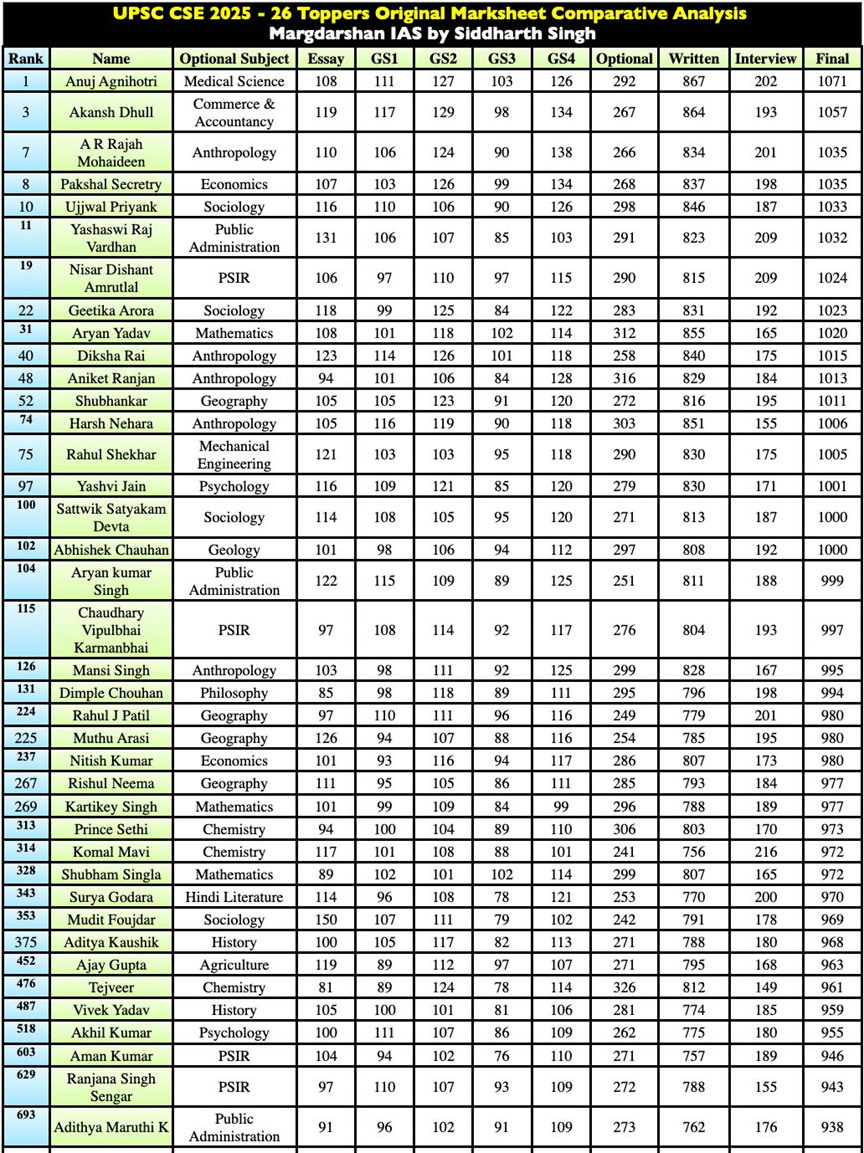
Before examining the myths and preparation lessons in detail, it is useful to first look at the paper-wise score distribution of successful candidates. The following tabular analysis presents the average performance across Essay, General Studies papers, Optional subjects, Written marks, Interview, and Final scores, helping us understand the realistic scoring range in the examination.
| Paper-Wise Score Distribution Of Recommended Candidates | |||||||||||
| Rank | Name | Optional Subject | Essay | GS1 | GS2 | GS3 | GS4 | Optional | Written | Interview | Final |
|---|---|---|---|---|---|---|---|---|---|---|---|
| 1 | Anuj Agnihotri | Medical Science | 108 | 111 | 127 | 103 | 126 | 292 | 867 | 202 | 1071 |
| 3 | Akansh Dhull | Commerce & Accountancy | 119 | 117 | 129 | 98 | 134 | 267 | 864 | 193 | 1057 |
| 7 | A R Rajah Mohaideen | Anthropology | 110 | 106 | 124 | 90 | 138 | 266 | 834 | 201 | 1035 |
| 8 | Pakshal Serectry | Economics | 107 | 103 | 126 | 99 | 134 | 268 | 837 | 198 | 1035 |
| 10 | Ujjwal Priyank | Sociology | 116 | 110 | 106 | 90 | 126 | 298 | 846 | 187 | 1033 |
| 11 | Yashaswi Raj Vardhan | Public Administration | 131 | 106 | 107 | 85 | 103 | 291 | 823 | 209 | 1032 |
| 19 | Nisar Dishant Amrutlal | PSIR | 106 | 97 | 110 | 97 | 115 | 290 | 815 | 209 | 1024 |
| 22 | Geetika Arora | Sociology | 118 | 99 | 125 | 84 | 122 | 283 | 831 | 192 | 1023 |
| 31 | Aryan Yadav | Mathematics | 108 | 101 | 118 | 102 | 114 | 312 | 855 | 165 | 1020 |
| 40 | Diksha Rai | Anthropology | 123 | 114 | 126 | 101 | 118 | 258 | 840 | 175 | 1015 |
| 48 | Aniket Ranjan | Anthropology | 94 | 101 | 106 | 84 | 128 | 316 | 829 | 184 | 1013 |
| 52 | Shubhankar | Geography | 105 | 105 | 123 | 91 | 120 | 272 | 816 | 195 | 1011 |
| 74 | Harsh Nehara | Anthropology | 105 | 116 | 119 | 90 | 118 | 303 | 851 | 155 | 1006 |
| 75 | Rahul Shekhar | Mechanical Engineering | 121 | 103 | 103 | 95 | 118 | 290 | 830 | 175 | 1005 |
| 97 | Yashvi Jain | Psychology | 116 | 109 | 121 | 85 | 120 | 279 | 830 | 171 | 1001 |
| 100 | Sattwik Satyakam Devta | Sociology | 114 | 108 | 105 | 95 | 120 | 271 | 813 | 187 | 1000 |
| 102 | Abhishek Chauhan | Geology | 101 | 98 | 106 | 94 | 112 | 297 | 808 | 192 | 1000 |
| 104 | Aryan kumar Singh | Public Administration | 122 | 115 | 109 | 89 | 125 | 251 | 811 | 188 | 999 |
| 115 | Chaudhary Vipulbhai Karmabhai | PSIR | 97 | 108 | 114 | 92 | 117 | 276 | 804 | 193 | 997 |
| 126 | Mansi Singh | Anthropology | 103 | 98 | 111 | 92 | 125 | 299 | 828 | 167 | 995 |
| 131 | Dimple Chouhan | Philosophy | 85 | 98 | 118 | 89 | 111 | 295 | 796 | 198 | 994 |
| 224 | Rahul J Patil | Geography | 97 | 110 | 111 | 96 | 116 | 249 | 779 | 201 | 980 |
| 225 | Muthu Arasi | Geography | 126 | 94 | 107 | 88 | 116 | 254 | 785 | 195 | 980 |
| 237 | Nitish Kumar | Economics | 101 | 93 | 116 | 94 | 117 | 286 | 807 | 173 | 980 |
| 267 | Rishul Neema | Geography | 111 | 95 | 105 | 86 | 111 | 285 | 793 | 184 | 977 |
| 269 | Kartikey Singh | Mathematics | 101 | 99 | 109 | 84 | 99 | 296 | 788 | 189 | 977 |
| 313 | Prince Sethi | Chemistry | 94 | 100 | 104 | 89 | 110 | 306 | 803 | 170 | 973 |
| 314 | Komal Mavi | Chemistry | 117 | 101 | 108 | 88 | 101 | 241 | 756 | 216 | 972 |
| 328 | Shubham Singla | Mathematics | 89 | 102 | 101 | 102 | 114 | 299 | 807 | 165 | 972 |
| 343 | Surya Godara | Hindi Literature | 114 | 96 | 108 | 78 | 121 | 253 | 770 | 200 | 970 |
| 353 | Mudit Foujdar | Sociology | 150 | 107 | 111 | 79 | 102 | 242 | 791 | 178 | 969 |
| 375 | Aditya Kaushik | History | 100 | 105 | 117 | 82 | 113 | 271 | 788 | 180 | 968 |
| 452 | Ajay Gupta | Agriculture | 119 | 89 | 112 | 97 | 107 | 271 | 795 | 168 | 963 |
| 476 | Tejveer | Chemistry | 81 | 89 | 124 | 78 | 114 | 326 | 812 | 149 | 961 |
| 487 | Vivek Yadav | History | 105 | 100 | 101 | 81 | 106 | 281 | 774 | 185 | 959 |
| 518 | Akhil Kumar | Psychology | 100 | 111 | 107 | 86 | 109 | 262 | 775 | 180 | 955 |
| 603 | Aman Kumar | PSIR | 104 | 94 | 102 | 76 | 110 | 271 | 757 | 189 | 946 |
| 629 | Ranjana Singh Sengar | PSIR | 97 | 110 | 107 | 93 | 109 | 272 | 788 | 155 | 943 |
| 693 | Adithya Maruthi K | Public Administration | 91 | 96 | 102 | 91 | 109 | 273 | 762 | 176 | 938 |
Top Scorers in Each Subject
| Subject / Paper | Top Scorer | Marks |
|---|---|---|
| Essay | Mudit Foujdar | 150 |
| GS1 | Akansh Dhull | 117 |
| GS2 | Akansh Dhull | 129 |
| GS3 | Shubham Singla | 102 |
| GS4 | A R Rajah Mohaideen | 138 |
| Optional Paper (Overall Highest) | Tejveer | 326 |
| Interview | Komal Mavi | 216 |
| Written Total | Anuj Agnihotri | 867 |
| Final Total | Anuj Agnihotri | 1071 |
Top Scorers by Optional Subject
| Optional Subject | Top Scorer | Marks in Optional |
|---|---|---|
| Medical Science | Anuj Agnihotri | 292 |
| Commerce & Accountancy | Akansh Dhull | 267 |
| Anthropology | Aniket Ranjan | 316 |
| Economics | Nitish Kumar | 286 |
| Sociology | Ujjwal Priyank | 298 |
| Public Administration | Yashaswi Raj Vardhan | 291 |
| PSIR | Nisar Dishant Amrutlal | 290 |
| Mathematics | Aryan Yadav | 312 |
| Geography | Rishul Neema | 285 |
| Mechanical Engineering | Rahul Shekhar | 290 |
| Psychology | Yashvi Jain | 279 |
| Geology | Abhishek Chauhan | 297 |
| Philosophy | Dimple Chouhan | 295 |
| Chemistry | Tejveer | 326 |
| Hindi Literature | Surya Godara | 253 |
| History | Vivek Yadav | 281 |
| Agriculture | Ajay Gupta | 271 |
Average Scores per Paper
| Paper | Average Marks |
|---|---|
| Essay | 107.31 |
| GS1 | 103.15 |
| GS2 | 111.46 |
| GS3 | 89.82 |
| GS4 | 115.64 |
| Optional | 281.33 |
| Written Total | 802.69 |
| Interview | 182.23 |
| Final Total | 984.92 |
Detailed Paper-wise Interpretation
- Essay: Average score is 107.31, indicating most candidates cluster around 100–110. Only a few exceptional scores (e.g., 150) significantly push the upper boundary.
- GS1 (History, Geography, Society): Average 103.15, showing moderate scoring. Marks remain relatively compressed due to analytical answer requirements.
- GS2 (Polity, Governance, IR): Average 111.46, slightly higher than GS1. Many candidates perform better here due to strong overlap with current affairs and static polity preparation.
- GS3 (Economy, Environment, Science & Tech, Security): Average 89.82, the lowest among GS papers, reflecting the traditionally difficult and technical nature of this paper.
- GS4 (Ethics): Average 115.64, the highest scoring GS paper. Structured answers, case studies, and ethical frameworks often allow candidates to secure higher marks.
- Optional Subject: Average 281.33, indicating that optional papers contribute heavily to rank differences. Scores above 300 generally provide a strong competitive advantage.
- Written Total: Average 802.69, suggesting that candidates crossing 830+ written marks are typically in a strong position for top ranks.
- Interview: Average 182.23, showing that most candidates fall in the 170–195 range, with exceptional scores crossing 200.
- Final Score: Average 984.92, meaning most candidates in this dataset fall between 960 and 1030 final marks
Key Insights from the Data
- GS3 is the most restrictive scoring paper, pulling down overall averages.
- Ethics (GS4) consistently boosts written scores.
- Optional papers create the largest variation in ranks due to the wide mark range (240–326).
- Interview scores remain moderately clustered, rarely determining rank alone but often acting as the final differentiator.
Myth vs Reality: Lessons from the UPSC CSE Score Data
Using the merged dataset of 39 successful candidates, several common beliefs about the Civil Services Examination can be tested against actual marks. The insights below convert the raw score patterns into clear, practical strategies for aspirants preparing for the next attempt.
Myth: “You must score extremely high in every paper.”
Reality from the Data:
The averages show that toppers do not dominate every paper.
| Paper | Average Marks |
|---|---|
| Essay | 107.31 |
| GS1 | 103.15 |
| GS2 | 111.46 |
| GS3 | 89.82 |
| GS4 | 115.64 |
Key Insight:
Even among top candidates, GS3 average is below 90, showing that candidates still secure high ranks despite relatively lower scores in difficult papers.
Actionable Strategy
- Aim for consistency rather than perfection: Target 100–110 in GS papers rather than chasing unrealistic 130+ scores.
- Focus on damage control: In tougher papers like GS3, preventing very low scores is more important than chasing exceptional marks.
- Strengthen answer structure: Clear introductions, subheadings, and examples can convert average answers into scoring ones.
Myth: “Optional subject alone decides the rank.”
Reality from the Data:
Average Optional Score: 281.33
Highest Optional Score: 326
Lowest Optional Score (in dataset): 241
Observation:
Candidates with both high and moderate optional scores appear across many ranks.
Actionable Strategy
- Choose optional based on understanding and interest, not trends.
- Target 270–300 marks, which appears to be the competitive range.
- Master answer-writing in optional papers, since presentation often differentiates between 260 and 300.
. Myth: “Interview marks alone determine the final rank.”
Reality from the Data
Average Interview Score: 182.23
Range observed: 149–216
Difference between many candidates’ interview marks is only 20–30 marks, which rarely overturns large written score differences.
Actionable Strategy
- Treat the interview as a polishing stage, not a rescue stage.
- Strong written performance remains the foundation of rank.
- Prepare for the interview through:
- Detailed DAF preparation
- Current affairs discussion
- Mock interviews for confidence and clarity
Myth: “Essay paper is unpredictable and impossible to prepare.”
Average Essay Score: 107.31
Highest Essay Score: 150
Most candidates fall between 100 and 120, suggesting the paper is more predictable than commonly believed.
Actionable Strategy
- Practice structured essay frameworks: introduction, thematic sections, multidimensional analysis, and balanced conclusion.
- Integrate examples from history, society, economy, ethics, and governance.
- Write essays regularly under timed conditions.
Myth: “Ethics (GS4) is unpredictable.”
Reality from the Data
Average GS4 Score: 115.64 (highest among GS papers)
This indicates that Ethics is actually one of the most scoring papers.
Actionable Strategy
- Develop conceptual clarity on ethical thinkers and values.
- Use real-life examples and case studies in answers.
- Practice case study frameworks: stakeholders, ethical dilemmas, options, and justified decisions.
Myth: “GS papers must be mastered completely before attempting answer writing.”
Reality from the Data
GS averages around 100–115, which means evaluation rewards clarity and structure more than exhaustive content.
Actionable Strategy
- Start answer writing early in preparation.
- Use simple frameworks:
- Definition or context in introduction
- 4–6 structured points in the body
- A forward-looking conclusion
- Add current examples to strengthen answers.
Myth: “The highest scorers are perfect in all sections.”
Reality from the Data
Even the top ranker shows variation between papers, confirming that UPSC rewards balanced performance rather than perfection.
Actionable Strategy
- Maintain a balanced preparation across all papers.
- Avoid neglecting any paper, especially Essay and Ethics which can boost scores.
- Prioritize revision cycles instead of continuously adding new material.
Core Strategic Lessons from the Data
- Consistency beats brilliance: steady scores around average or slightly above average across papers produce high ranks.
- Optional preparation must be systematic, as it contributes the largest portion of marks.
- Essay and Ethics offer opportunities to outperform the average candidate.
- Interview preparation refines personality but cannot compensate for weak written scores.
Conclusion
The data clearly shows that success in the Civil Services Examination is not about extraordinary marks in every paper but about balanced, disciplined, and strategic preparation. Candidates who focus on consistent performance, structured answers, and strong optional preparation place themselves in the strongest position to secure a high rank in the next attempt.